I think that the products I have created consisting of my film trailer and subsequently my film magazine cover and promotional poster, conform to existing media products fairly well, as it was from existing products that I took my inspiration, initiative and ideas about what to include in my own products.
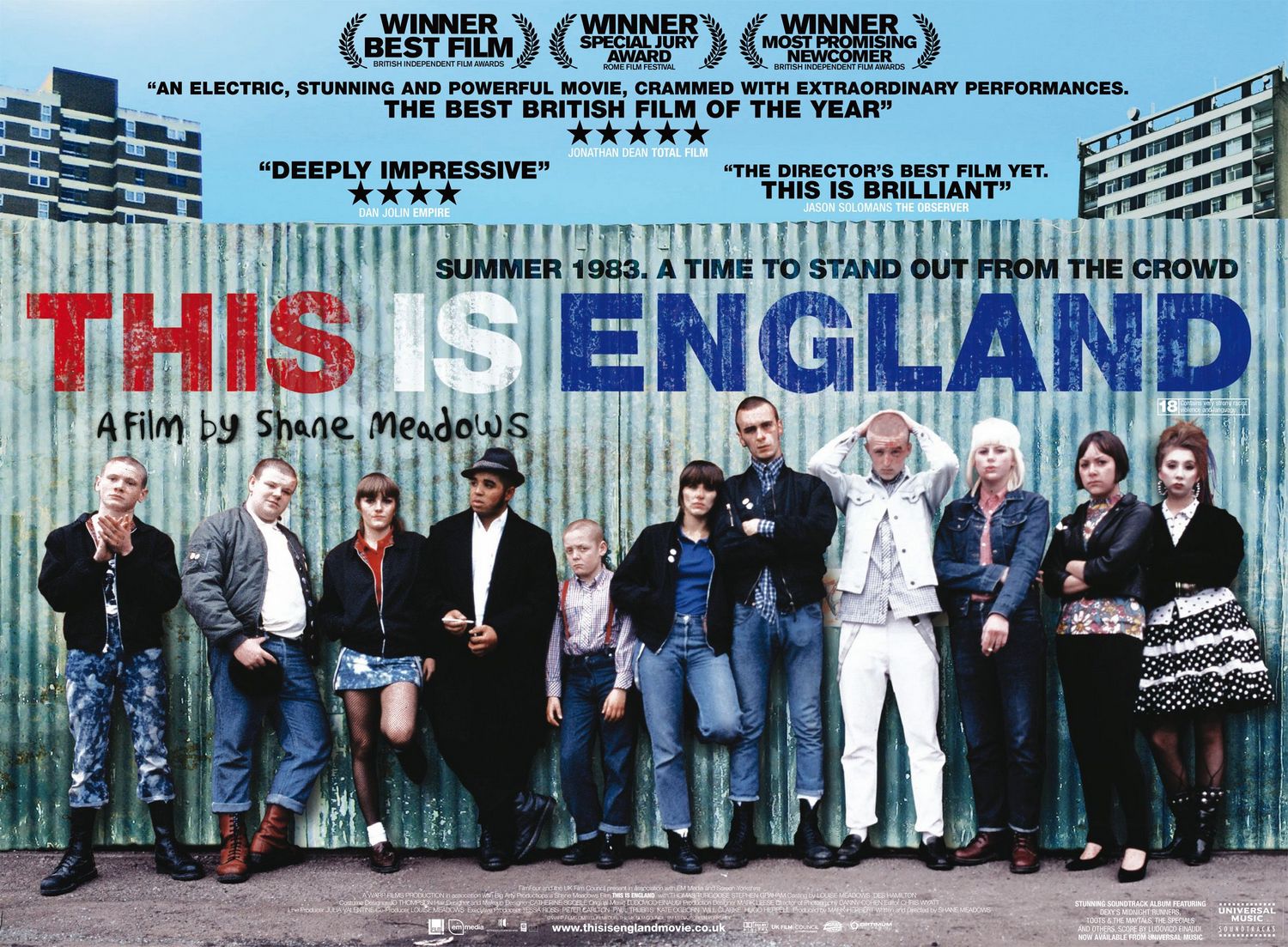
To ensure that we were clear as to which Codes and Conventions to stick to and those which we felt to ignore we studied the conventions in great detail and identified in Boyle's work where he had implemented them effectively. First of all, we identified the Codes and Conventions of the genre, as shown below:
Location Shooting
Wide Shots- Wide Shots are important given their wide expanse and coverage. In short, they can cover a wide area in a shot with the camera remaining static. The wide shot allows viewers to feel slightly voyeuristic as in places, and if used effectively, it can seem as if the viewer is intruding into a private matter that it was unintended for them to witness.
Non- Professional Actors- Typically Social Realism films launch the careers of aspiring actors. These actors tend to be in need of an opportunity to showcase their talents on the platform of the film medium. Relatively cheap to make and with low production costs, it is the Social Realism genre that tends to allow new actors an opportunity to express their talent. As Social Realisms are generally fairly cheap to make there is little financial risk associated with bringing in an inexperienced actor to portray a character. In conjunction with this is the possibility that new talent requires a proving ground of sorts, not just to be recognised as a serious talent but in order for their skills to be honed appropriately by a director. Within our own film opening, we used amateur actors for the aforementioned reasoning. We found that through the professionalism and dedication of our actors, they contributed extremely positively to the successful outcome of our project. Similarly in Boyle's film, he hired unknown actors at the time of the production of Trainspotting who, in the aftermath of starring in the production have subsequently gone on to further their acting careers into household names in more prominent, and arguably more established and lucrative genres such as the Action/ Adventure genre.
Semi- Improvised Scripts- Whilst being a convention of the genre and one which, in the early planning and research stages, we were looking to replicate within our own work, in the end we decided against conforming to the convention of a semi- improvised script, as whilst providing strong creative input from an actor into how a character might react in a given situation we felt it was more appropriate to use the carefully considered and pre prepared dialogue that was written on the script rather than planning before a scene what the dialogue would be as we felt ultimately it would prove to be unnatural and it would seem forced something that we were keen to avoid.
Humour and Seriousness- Given the dark nature of the piece we knew that in a feature length production we would contrast the dark moments of the script with lighter humour highlighted through the inclusion of dry humour and a strong sense of camaraderie from the central characters.
The erosion of regional identities
Wider social issues explored via emotional and dramatic individual stories- This was perhaps the Code and Convention that we endured we stuck to the most. As our overarching plot is of an isolated male seeking redemption and the annulment of a crippling addiction the story, whilst focussing very much on the central protagonists throws up the wider issue of recreational drug use. We are confident that viewers will be able to see the unquestionable consequences of making such an ill fated decision in turning to the habit for pleasure and release, from the mundane norm of everyday reality.
Further to this through our analysis of Boyle's work we uncovered that his use of camera angles were particularly effective. Of particular worthy mention is how I feel we replicated the POV shot from "The Worst Toilet in Scotland" scene from Boyle's film and applied this technique to our own work as can be evidenced in the two clips below.
https://www.youtube.com/watch?v=7RoMaS1pzOE (2:16)
and that of our own trailer:
https://www.youtube.com/watch?v=ZxR5VxbK31Q (1:20)
We felt it very important that all three of the products shared and maintained a dark and sinister look and mood about them as we knew that it was crucial the marketing had to reflect the overall feeling of the film in it's entirety were it to be publicly produced. For this reason the mood in all of the products was set to replicate a consistently dark and unnerving feeling, as both Zach and I concluded this would be the overall effect we wanted to immerse onto our viewers. This was due to the dark nature of the story and the central protagonist's ill remedied shortcomings as he battles to overcome his twisted addiction to drugs.

Being a film that would hopefully, ultimately fit into the Social Realism genre we felt it important that the audience would easily be able to connect with the character of Toby Scott on an emotional, subjective level. Although however, we did appreciate, and subsequently were mindful of, the fact that some audience members may perhaps find it both difficult and challenging to empathise with the character's situation owing and being very much dependent on the level of exposure they have experienced in the oppressive, often vicious cycle of recreational drug use.

I believe that our film is very much reminiscent and echoes sentiments of existing films of the Social Realism genre. Indeed, we took the majority of our ideas and themes from Danny Boyle's classic film "Trainspotting", a widely attributable film title that champions the genre of Social Realism. With it's success very well known and documented, bearing little secret as to it's popularity through it's widely discussed nature, we knew this was a film that we had to look extremely carefully at in order to extract the best bits from and apply them systematically to our own work. Indeed, in the trailer for Boyle's film, a dark, sinister, urban feeling is evoked, however, beneath the superficial bleakness and depravity that is portrayed, there remains between the protagonists in the trailer a kindred spirit and united bond of friendship, binding all of the characters together in a strong unity. This is highlighted in Boyle's work through the unveiling of the character's surnames in the trailer whilst the picture is frozen in a black and white background. Through implementing this into his work, Boyle is allowing his audience, through the short space and time constraints of a trailer to be able to begin to connect with the characters in his work. This is something that we ourselves were largely hoping to replicate within our own trailer. This is an aspect of Boyle's work that we were looking to replicate effectively in our own work. We were able to achieve this effectively through the introduction of the character of "Marty Smith" that appears in the trailer who acts as a companion to Toby throughout the course of our trailer. We decided to show the names of the characters upon the screen as opposed to actor billing as we knew stylistically the audience would not be expecting to see this within our trailer.
Also, by screening the characters names onto the screen, within the short time capacity of the trailer, the audience are already beginning to become accustomed to our characters and are beginning to get to know them.
Another aspect of our trailer that was modelled on Boyle's work was the interaction the viewer experiences with the central protagonist in the trailer. This is a tactic similarly deployed by Boyle in order for his audience to be able to connect to his characters to a greater extent. Lending from Trainspotting we thought it a good idea in our trailer to have our central protagonist share a greater intimacy with our audience in the trailer so the relationship between protagonist and audience has a chance to grow and flourish. We achieved this, I feel effectively, through the means of the central protagonist narrating our trailer as well as acting as a continuing referencing point of structure in our trailer as we spliced our footage with the protagonist's webcam address which is a continual point of reference throughout the trailer to allow the audience to get to know the character on a far more personal level.

Continuing our project's inspiration from Trainspotting, I feel that our central protagonist, Toby Scott, shares consistencies and similarities with Mark Renton in that he finds his drug addiction an inescapable omen, a burden to be saddled with and one he must rid himself of. We thought it important and significant that Toby should share some similarities with Mark as idealistically the viewers of our trailer will be familiar with Boyle's film. Having this grounded foundation in being able to identify with a character of a similar nature is something that we hope would attract audiences to viewing our film. The use of a dark colour palette used in the Mise En Scene within our trailer is something that we were keen for our trailer to feature to provide an indication of the dark and sinister nature of the world of drugs. For example, within the opening tracking shot of the walking feet within our trailer, as the camera begins to rise up, a dark hoodie can be observed by the viewer as being worn by one of the characters within the film with the intended effect being one of providing an indication as to the film's sinister plot. Similarly, location was also used to unnerve the viewer through the lack of lighting available, creating an immersive and brooding atmosphere for the viewer. The use of blacks, greys and whites are colours similarly deployed by Boyle in his own trailer. Indeed, within one of the opening shots, we see a dark grey backdrop as the camera focuses on Renton running from some kind of danger. The Soundtrack to our own work, in direct contrast to Boyle's work which is of a more uplifting and carefree disposition, was one full of dramatic tension and a fast pace in order to make the trailer feel exciting and move at a quick pace. The constant rise in music levels building to a dramatic crescendo of sound helps to immerse the viewer ever more effectively into the world of the film, aiding further their suspension of disbelief.

Whilst I feel that I conformed to the Codes and Conventions of the social Realism genre within the main coursework task it was the Codes and Conventions for a magazine cover I feel that I subverted for particular effect with my Ancillary Tasks. I chose to do this for a number of reasons.
As Social Realism is an altogether alternative genre, removed from any of the "mainstream" genres such as Action and Adventure, Thriller, or, Romantic Comedy, I decided a different tact was required in order to attract a particular audience and specified readership towards my fictitious magazine publication. Due to this being the case, I decided to distance the magazine from most of the Codes and Conventions normally associated with one such as not having my magazine feature a barcode or price, as subverting the expected conventions would create a feeling of abnormality and uniqueness about the publication, in turn, allowing the publication to be more widely absorbed by a greater number of the target demographic, with the intended aim being to draw them to the publication as it will stand out due to it's uniqueness. The omission of the stylistic features of both the price and barcode information were intended as my magazine is promoting the genre of Social Realism, a genre where financial impetus is hard to come by. As a direct consequence of this, my magazine, if in full production, would most probably be a free magazine with it's primary revenue avenue being a direct source of paid for advertising space within the magazine.

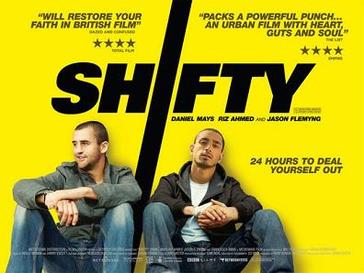
It was in straying away from the practised Codes and Conventions that I took the majority of my creative decisions regarding my own film poster. Like the film magazine, although Zach and I were working as a pair for the majority of the task, our Ancillary Tasks could share consistent themes such as font and lettering as well as ideas but ultimately they had to remain as original and individualised pieces of work. As inspiration for my poster, I looked at the example of existing Social Realism film "Shifty", where the poster is very much reminiscent of what I myself was hoping to create in that the poster is focussing on two characters and their personal journey. Indeed, this is very similar to the vision I had in mind for my own poster when creating it. Like the film Shifty my poster also focuses primarily on a character's journey, the contrast being however that in my own work, the character appears isolated and alone, symbolising that he has to take up the fight against his addiction alone, whereas in the poster for Shifty it is clear that the two characters share some sort of connection in either friendship or familial bond and crucially their faces are already known to the audience, fitting a convention of the genre as the audience is already able to successfully identify with the main protagonists of the piece prior to seeing the film in full. I also tried to follow the systematic, logical layout of the Shifty film poster by having my film title in the middle of the poster and then being separated into quadrants.

On my own poster, I chose to obscure the character's face from view so as to reinforce the idea that Toby's experiences that are documented within the film could happen to anyone and everyone. Similarly, another reason for choosing to obscure the characters face from view in my poster is the fact that Toby's identity remains concealed and hidden and furthermore will encourage more people to go and see the film upon release as they will want to uncover his true identity. Stylistically, I subverted the convention of attaching billing to my film poster as I feel that this would have detracted from the overall dark look of the piece had brightly coloured billing been included on the poster. I conformed to the convention of attaching quotations from press reviews and film critics from reputable publications such as British broadsheet Berliner style newspaper "The Guardian", a mainstream left wing publication supporting the "Indie" style of film that our film would ultimately fall into. Similarly, I also included a quotation from mainstream film magazine "Total Film" to highlight the secondary mainstream audience we were aiming to target besides just fans of the Social Realism genre.
In conclusion, I feel that I have conformed to, as well as subverted, well established Codes and Conventions of the Social Realism genre to great effect across my three tasks to provide realistic products all of which I'm extremely proud to say that I have created.

No comments:
Post a Comment